Choosing the right software development company can determine whether your product becomes a dependable business asset or an expensive source of technical debt. The best partner understands your goals, asks practical questions, explains trade-offs clearly, and has the technical expertise to build and support software around the way your business works.
To choose a software development company, compare its relevant experience, product discovery approach, communication, development methodology, security practices, pricing, ownership terms, and post-launch support. Do not select a vendor based on a proposal or hourly rate alone. Evaluate whether the team can understand your requirements and deliver a maintainable product at a sensible level of scope.
This guide provides a practical framework for comparing software development partners during the consideration and decision stage. For broader guidance on planning and building a tailored product, see our guide to a custom software development company.
What Should You Define Before Choosing a Software Development Company?

A development partner can help refine your idea, but you should still define the business problem and desired outcome before requesting proposals. Clear inputs make it easier to compare vendors fairly and reduce the chance of receiving estimates based on different assumptions.
Document the following before speaking with potential partners:
- Business objective: Explain the process, customer problem, or market opportunity the software should address.
- Target users: Identify customers, employees, administrators, partners, or other user groups.
- Core workflows: Describe the most important actions the product must support.
- Initial scope: Separate essential MVP features from useful enhancements and future ideas.
- Integrations: List existing systems, APIs, payment providers, identity services, data sources, and third-party tools.
- Constraints: Note compliance requirements, deadlines, preferred platforms, budget limits, and internal resources.
- Success criteria: Define what a successful first release should enable or improve.
You do not need a complete technical specification. A capable software development partner should help turn business requirements into user stories, technical decisions, priorities, and a realistic delivery plan.
How Do You Evaluate Technical Experience?
Look for experience that is relevant to your product, not simply a long list of technologies. A team that has built a similar workflow, user experience, integration, or operating model may be more useful than a vendor that claims expertise in every framework.
Ask prospective companies:
- Have you built products for a similar industry, audience, or business model?
- Can you explain which parts of previous work are relevant to our requirements?
- Have you delivered web applications, mobile applications, SaaS development projects, AI products, or internal systems like ours?
- Who will make architecture and technical decisions on our project?
- How do you handle legacy systems, unfamiliar APIs, data migration, and third-party dependencies?
- Can we speak with the people who would actually work on the product?
Review case studies for the problem, scope, responsibilities, technology choices, and outcome described. Be cautious when a portfolio only shows attractive screens without explaining the engineering work behind them.
Why Do Discovery and Planning Matter?
Product discovery is one of the clearest ways to assess how a company thinks. During discovery, the team should examine your users, workflows, business rules, data, risks, and priorities before recommending a solution.
A useful discovery phase may produce:
- User journeys and workflow maps
- Prioritized requirements and MVP scope
- Wireframes or early UX direction
- Integration and data considerations
- Technical architecture recommendations
- Delivery phases, assumptions, risks, and decision points
Ask what discovery includes, who participates, what you receive at the end, and whether the discovery fee is separate from development. A thoughtful planning process should make uncertainty visible rather than hide it behind a confident promise.
CodeMyPixel combines discovery, design, engineering, integrations, and ongoing improvement. You can review our custom software development process to understand how a project can move from requirements and planning to launch and support.
How Should You Compare Communication and Methodology?
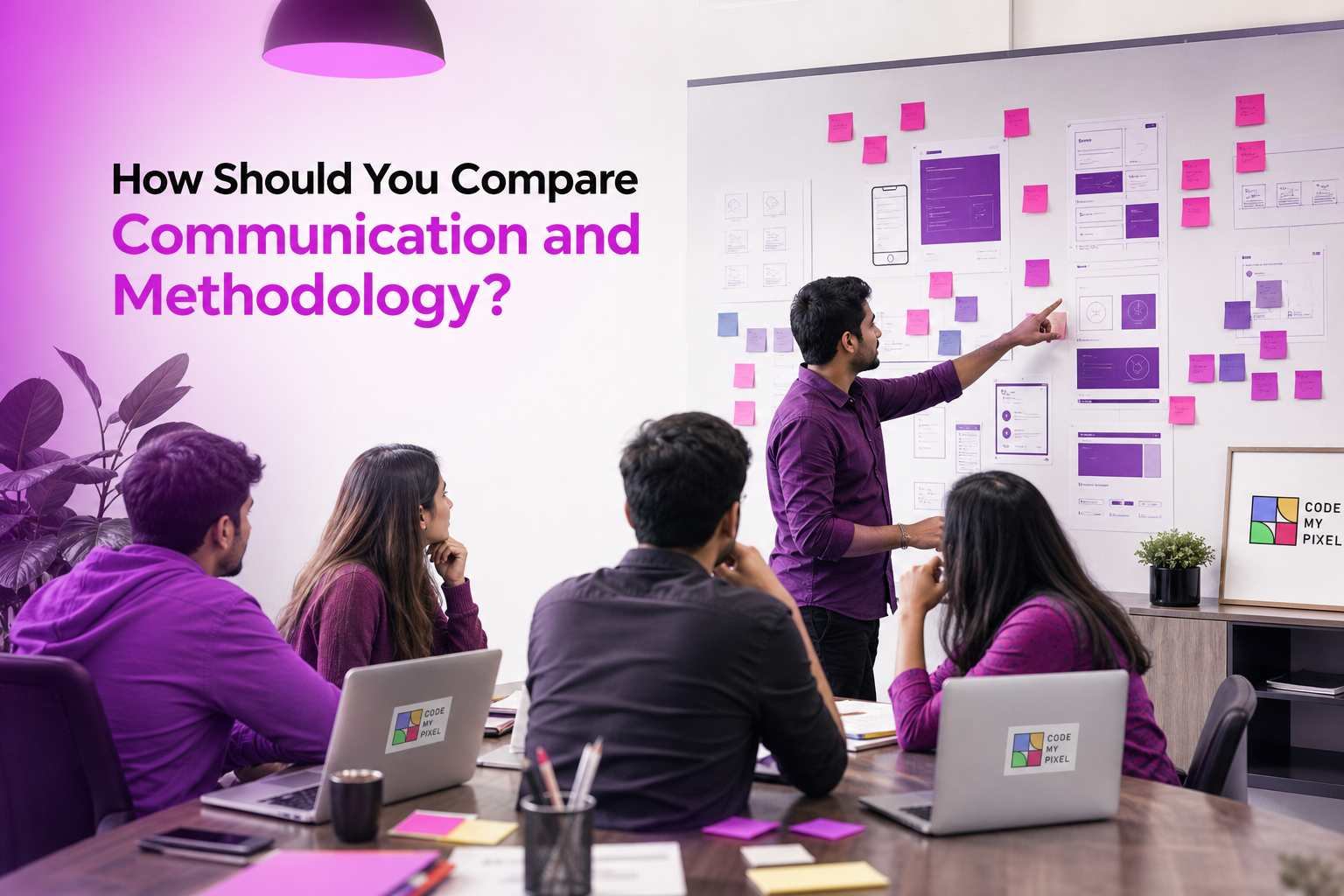
Strong communication is not the same as frequent meetings. The right partner creates a reliable system for decisions, progress updates, feedback, documentation, and escalation.
Clarify:
- Who is your day-to-day contact?
- How often will you receive progress updates or demonstrations?
- Which tools will manage tasks, designs, documentation, and technical issues?
- How quickly are questions and blockers normally acknowledged?
- How are scope changes evaluated and approved?
- Which decisions require your approval?
Most custom projects benefit from an iterative methodology. Work is divided into manageable increments, demonstrated regularly, and adjusted as the team learns more. This approach can reduce avoidable rework, but it still requires agreed priorities, acceptance criteria, and decision ownership.
Ask how the proposed methodology will work in practice rather than accepting a label such as agile or waterfall. A good process should match the complexity, risk, and maturity of your project.
What Should You Ask About Security and Quality Assurance?
Software security should be considered from the beginning, not added shortly before launch. Your development partner should understand authentication, authorization, data protection, secure integrations, secrets management, backups, logging, and safe deployment practices.
Ask how the team will:
- Separate user roles and permissions
- Protect sensitive information in transit and at rest
- Manage credentials, API keys, and environment access
- Validate and sanitize user input
- Monitor errors, suspicious activity, and system health
- Handle backups, recovery, dependency updates, and security incidents
Quality assurance should cover more than visual inspection. Ask whether the project includes functional testing, integration testing, responsive testing, regression testing, performance checks, and user acceptance testing. Confirm how defects are recorded, prioritized, fixed, and verified before release.
How Do Technology Decisions, Integrations, and Scalability Affect Vendor Fit?
Technology should serve the product and its operating requirements. A vendor should be able to explain why a particular framework, database, hosting model, AI service, or architecture is appropriate for your current needs and likely growth.
Discuss expected users, transaction volume, data sensitivity, geographic availability, integration dependencies, maintenance requirements, and future features. Scalability does not mean overbuilding every component on day one. It means making sensible decisions that avoid unnecessary rework as usage and complexity increase.
Integrations deserve special attention because third-party systems can control timelines, costs, and reliability. Ask about API limits, authentication, webhooks, data mapping, failure handling, monitoring, and ownership of integration credentials. A partner with relevant technical expertise should identify these risks during discovery.
How Should You Compare Software Development Company Pricing?
Software development company pricing depends on scope, requirements, complexity, integrations, design depth, technology choices, team composition, and support needs. An estimate is only meaningful when you understand the assumptions behind it.
| Pricing question | What to clarify |
|---|---|
| Scope | Which features, platforms, integrations, environments, and revisions are included? |
| Estimate type | Is the proposal fixed scope, time and materials, or a phased estimate? |
| Assumptions | What information, content, access, decisions, or third-party services must you provide? |
| Change requests | How are new requirements priced, approved, and added to the plan? |
| Ongoing costs | What will hosting, licenses, maintenance, monitoring, support, and third-party services cost? |
| Payment terms | When are deposits, milestones, invoices, and final payments due? |
Costs and schedules depend on scope and requirements. Be cautious of unusually low estimates that exclude discovery, testing, deployment, documentation, or support. Compare the total expected cost and business value rather than choosing the lowest initial quote.
Who Owns the Code, Documentation, and Product Assets?
Ownership should be addressed in the contract before development begins. Confirm who owns the custom source code, designs, documentation, database schemas, configuration, domain assets, and project data after payment.
Also ask about:
- Access to source repositories and hosting accounts
- Open-source licenses and third-party components
- Use of pre-existing libraries or reusable vendor code
- Transfer of credentials and deployment instructions
- Documentation standards and handover materials
- Confidentiality, data handling, and termination arrangements
A professional partner should make it possible for your business or another qualified team to understand and operate the product. Ownership is not complete if you receive code but cannot deploy, maintain, or extend it.
What Post-Launch Support Should You Expect?
Launch is a transition point, not the end of a software project. Ask what post-launch support includes, how long the initial warranty or stabilization period lasts, and how ongoing work is requested and priced.
Useful post-launch support may include production monitoring, bug fixes, deployment assistance, security updates, performance reviews, backup checks, analytics review, and planned improvements. Confirm support hours, response expectations, emergency procedures, and whether the original development team remains available.
If you are building a SaaS platform or internal business system, ongoing maintenance is particularly important because integrations, browsers, operating systems, dependencies, and security risks change over time.
How Can References and Case Studies Help You Decide?
References and case studies can validate a vendor’s communication, reliability, technical judgment, and ability to work through uncertainty. Ask for references from projects with a similar engagement model or level of complexity, where appropriate.
Useful questions for a reference include:
- Did the company understand the business problem?
- How transparent were communication and estimates?
- How did the team handle changes or difficult technical issues?
- Was the delivered software maintainable and usable?
- Was documentation and ownership handled clearly?
- How responsive was post-launch support?
When reviewing case studies, distinguish between the vendor’s direct contribution and the broader client’s results. Look for specific responsibilities and delivery details rather than unsupported claims.
What Red Flags Should You Watch For?
The following warning signs should prompt additional questions or a decision to continue your search:
- Guarantees about results, rankings, revenue, or an exact delivery date before requirements are understood
- A low quote with no scope, assumptions, testing plan, or support details
- Inability to explain technical decisions in clear business language
- Unwillingness to identify the team members who will do the work
- Vague answers about source-code ownership, security, or documentation
- Portfolio examples that cannot be verified or explained
- Pressure to approve a proposal before discovery or meaningful discussion
- No clear process for feedback, changes, defects, or escalation
- Dependence on one person with no continuity or knowledge-transfer plan
One concern may not disqualify a vendor, but repeated vagueness is a serious risk when you are entrusting a partner with product, customer, or operational data.
Custom Software Development Company Evaluation Checklist
Use this checklist to compare finalists consistently. Score each provider against your actual priorities rather than relying on presentation quality.
| Evaluation area | Questions to answer | Strong evidence |
|---|---|---|
| Business understanding | Does the team understand the problem and users? | Relevant questions, clear assumptions, and practical recommendations |
| Technical expertise | Can it build and maintain the required product? | Relevant examples, capable team, and understandable architecture discussion |
| Discovery | Will uncertainty be reduced before implementation? | Defined discovery activities, outputs, risks, and priorities |
| Communication | How will progress and decisions be managed? | Named contacts, reporting rhythm, tools, and escalation path |
| Security and QA | How will the product be protected and tested? | Documented practices for access, testing, releases, and incident handling |
| Commercial fit | Are the estimate and terms understandable? | Transparent scope, assumptions, exclusions, milestones, and ongoing costs |
| Ownership | Will you control the product assets? | Clear contract terms, repository access, documentation, and handover |
| Support | What happens after launch? | Defined warranty, maintenance, monitoring, and support arrangements |
Why Choose CodeMyPixel as Your Software Development Partner?
CodeMyPixel helps startups, growing businesses, and product teams plan, design, build, and operate custom digital products. Our work can include web applications, mobile apps, SaaS platforms, AI-powered software, internal systems, integrations, and ongoing technical support.
We focus on understanding the business problem before recommending implementation. Our approach brings together product discovery, UX/UI design, modern engineering, quality assurance, deployment, and post-launch improvement. This lets you evaluate the project as a complete product rather than a collection of isolated development tasks.
Explore our custom software development services to see how CodeMyPixel can support your requirements, technology decisions, integrations, and long-term product goals.
Frequently Asked Questions
How do I choose a software development company for an MVP?
Choose a partner that can help prioritize the MVP around a clear user problem, validate assumptions, explain trade-offs, and build a maintainable foundation. Ask how discovery, testing, analytics, ownership, and future improvements are included.
What should I include in a software development request for proposal?
Include your business objective, target users, key workflows, desired platforms, initial features, integrations, constraints, security needs, preferred launch conditions, and requested proposal format. Explain which items are essential and which are flexible.
Should I choose a fixed-price or time-and-materials engagement?
Either model can work. Fixed-price projects require well-defined scope and assumptions, while time and materials can provide more flexibility as requirements evolve. Ask how changes, approvals, reporting, and budget control work under the proposed model.
How much does it cost to hire a custom software development company?
There is no responsible universal price. Cost depends on the product type, scope, design, integrations, technical complexity, team composition, testing, infrastructure, and support. Request a phased estimate that clearly identifies assumptions and exclusions.
What is the most important quality in a software development partner?
Reliable judgment is essential. The partner should understand your business, communicate risks early, make defensible technical decisions, and maintain quality while adapting to new information.
How long does custom software development take?
Schedules depend on scope, requirements, team capacity, integrations, feedback cycles, testing, and launch conditions. A responsible company should provide a planning range or phased schedule after understanding the project rather than guaranteeing an arbitrary timeline.
Book a Custom Software Discovery Call
If you are comparing vendors or need help turning an idea into a practical product plan, book a custom software discovery call with CodeMyPixel. We can discuss your business goals, users, workflows, MVP priorities, integrations, technical requirements, and support expectations.
Book a custom software discovery call with CodeMyPixel and take the next step toward software that fits the way your business works.